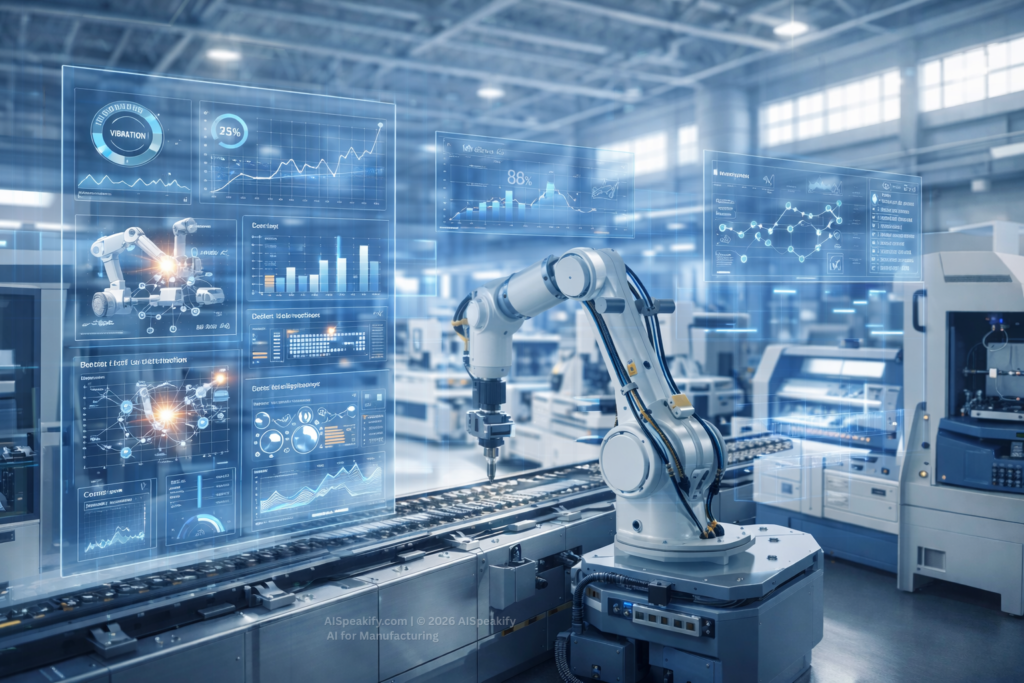
Industrial Artificial Intelligence for Modern Manufacturing Operations
AI applications used by plant managers, operations teams, reliability engineers, and industry leaders. Data-driven optimization for predictive maintenance, quality control, OEE monitoring, and production intelligence.
Artificial Intelligence is transforming modern manufacturing operations by improving uptime, quality control, production planning, and operational efficiency. From predictive maintenance to AI-driven scheduling and analytics, manufacturers are using industrial AI to reduce downtime, improve yield, and increase throughput.
- Reduce unplanned downtime
- Improve quality and defect detection
- Optimize scheduling and throughput
👉 On This Page
Why AI Matters in Manufacturing
Manufacturing environments operate under tight constraints:
- High equipment utilization
- Strict delivery timelines
- Quality compliance requirements
- Increasing labor costs
- Complex supply chains
AI systems enhance decision-making by analyzing machine signals, production data, maintenance logs, ERP information, and real-time sensor inputs — identifying patterns invisible to manual review.
When implemented correctly, AI in manufacturing typically delivers:
- 15–40% reduction in unplanned downtime
- 5–20% reduction in scrap and rework
- 10–25% improvement in scheduling efficiency
- Improved asset lifecycle performance
Core AI Applications in Manufacturing
Artificial Intelligence in manufacturing is not a single technology implementation. It is a layered transformation across maintenance, production, quality, planning, supply chain, and operational intelligence systems. Modern industrial AI deployments integrate machine learning, computer vision, optimization algorithms, and real-time analytics to convert operational data into measurable performance improvements.
Below are the primary AI application domains transforming manufacturing environments.
Predictive Maintenance
Predictive maintenance uses machine learning models trained on vibration signals, temperature readings, acoustic data, oil analysis, and operational load patterns to detect early failure signatures in rotating equipment, CNC machines, compressors, pumps, and robotic assemblies. Instead of reactive breakdown maintenance or fixed preventive schedules, AI models calculate remaining useful life (RUL) and failure probability scores.
Operational Impact:
- Reduction in unplanned downtime (20–50% typical range)
- Lower spare parts inventory requirements
- Improved asset utilization
- Extended equipment lifecycle
- Data-driven maintenance planning
Integration typically occurs with:
- CMMS systems
- ERP maintenance modules
- MES downtime tracking
- Edge IoT sensors and PLC data streams
Vision Inspection & Automated Quality Control
Computer vision systems powered by deep learning convolutional neural networks (CNNs) analyze images from high-speed cameras to detect surface defects, dimensional deviations, assembly errors, and cosmetic flaws.
Applications:
- PCB defect detection
- Weld seam inspection
- Surface scratch identification
- Packaging quality verification
- Dimensional measurement validation
Measurable Benefits:
- Reduced scrap and rework
- Faster inspection cycles
- Lower labor dependency
- Higher first-pass yield
These systems often integrate with:
- PLC trigger systems
- MES quality modules
- Real-time rejection mechanisms
- Production dashboards
Production Scheduling & Optimization
Advanced production scheduling platforms use constraint-based optimization and reinforcement learning algorithms to generate optimal production sequences.
AI-driven scheduling considers:
- Machine availability
- Labor constraints
- Tool changeover time
- Order priority
- Material availability
- Delivery deadlines
Outcomes:
- Reduced changeover waste
- Higher on-time delivery
- Improved capacity utilization
- Reduced WIP inventory
- Increased production stability
Integration typically connects to:
- ERP order management
- MES dispatch systems
- Shop floor control systems
OEE & Manufacturing Analytics
AI enhances Overall Equipment Effectiveness (OEE) monitoring by moving beyond static dashboards into predictive operational intelligence. Instead of simply reporting availability, performance, and quality metrics, AI systems analyze trends to predict bottlenecks, micro-stoppages, and throughput degradation before they escalate.
Capabilities:
- Automated root cause analysis
- Performance drift detection
- Throughput forecasting
- Shift-based productivity modeling
- Cross-line efficiency comparison
Data sources include:
- MES
- SCADA
- PLC signals
- Production counters
- ERP production data
Process Optimization & Digital Twin Modeling
AI-driven process optimization analyzes sensor data, historical yield data, and parameter settings to identify optimal operating conditions. Digital twins simulate production processes in virtual environments, enabling predictive experimentation without disrupting live operations.
Common Use Cases:
- Injection molding parameter tuning
- CNC cycle time optimization
- Chemical batch process control
- Energy consumption optimization
- Thermal system stabilization
Supply Chain & Demand Forecasting
Machine learning forecasting models analyze historical demand patterns, seasonality, lead times, supplier variability, and macroeconomic indicators to generate accurate production demand forecasts.
Business Benefits:
- Reduced inventory holding costs
- Improved raw material planning
- Fewer stockouts
- Smarter procurement strategies
- Reduced bullwhip effect
Energy Optimization & Sustainability Analytics
AI analyzes power consumption patterns across machines, compressed air systems, HVAC, and thermal processes to identify inefficiencies. Energy optimization directly impacts operational cost reduction and sustainability reporting compliance.
Capabilities:
- Peak demand prediction
- Load balancing
- Energy waste detection
- Carbon footprint analytics
- ESG performance tracking
AI-Powered Documentation & Knowledge Automation
While not operational AI in the classical sense, documentation AI improves administrative efficiency and reduces knowledge loss.
Generative AI is increasingly used to:
- Auto-generate SOP documentation
- Convert maintenance logs into structured insights
- Summarize production reports
- Assist engineering teams with root cause analysis documentation
- Generate quality audit reports
Artificial Intelligence in manufacturing is not limited to a single department. Its impact spans reliability engineering, operations management, production planning, quality control, and executive decision-making. Organizations that implement AI strategically across multiple domains gain compound efficiency advantages, operational resilience, and competitive differentiation.
How AI Integrates Into Manufacturing Systems
Artificial Intelligence in manufacturing does not operate in isolation. It integrates into existing operational technology (OT) and information technology (IT) environments through structured data pipelines, industrial protocols, and layered system architecture.
Successful AI deployment requires alignment across shop-floor devices, control systems, data infrastructure, enterprise platforms, and cloud or edge computing environments. Understanding this integration architecture is critical for scalability, cybersecurity, and measurable ROI.
Manufacturing environments typically follow a hierarchical structure aligned with ISA-95 standards:
- Level 0–1: Physical process & sensors (machines, PLCs, IoT devices)
- Level 2: SCADA / HMI systems
- Level 3: Manufacturing Execution Systems (MES)
- Level 4: Enterprise Resource Planning (ERP)
- Cloud / Edge Layer: Data processing, AI modeling, analytics
AI solutions integrate across these layers depending on the application domain.
Data Acquisition Layer (Edge & PLC Integration)
AI begins with data.
Data is collected from:
- PLC signals (cycle time, alarms, counters)
- Vibration and acoustic sensors
- Temperature and pressure transducers
- Machine controllers (CNC, robots)
- Vision cameras
- Energy meters
- Barcode and RFID systems
Integration occurs through industrial communication protocols such as:
- OPC-UA
- Modbus TCP/IP
- Ethernet/IP
- Profinet
- MQTT
Edge computing devices often preprocess this data before transmitting it to centralized AI platforms, reducing latency and bandwidth usage.
Data Processing & Storage Layer
Raw machine data must be structured, timestamped, and contextualized.
AI platforms integrate with:
- Industrial data historians
- Time-series databases
- MES production records
- ERP order data
- Maintenance logs (CMMS)
- Quality inspection records
Data normalization ensures that machine-level signals align with production context (e.g., linking vibration data to specific work orders or batch IDs).
This contextualization transforms raw signals into meaningful operational intelligence.
Integration with MES & ERP Systems
AI insights must feed back into operational systems to drive action.
MES Integration:
- Automatic downtime categorization
- Predictive quality alerts
- Production rescheduling recommendations
- OEE performance forecasting
ERP Integration:
- Maintenance planning adjustments
- Inventory rebalancing
- Procurement automation
- Demand forecast updates
Without integration into MES and ERP, AI becomes a reporting tool rather than an operational driver.
AI Model Layer (Analytics & Learning Systems)
At this stage, machine learning models are trained and deployed.
Common AI models used in manufacturing include:
- Supervised learning models for defect classification
- Anomaly detection algorithms for predictive maintenance
- Reinforcement learning for scheduling optimization
- Regression models for yield forecasting
- Time-series forecasting models for demand prediction
These models operate in one of three modes:
- Batch analysis (historical trend evaluation)
- Near-real-time analytics (minute-level insights)
- Real-time edge inference (millisecond-level decisions)
Visualization & Decision Support Layer
Modern systems emphasize prescriptive analytics — not just “what happened,” but “what should be done next.” This moves AI from descriptive to decision-enabling.
AI outputs are delivered through:
- Real-time dashboards
- KPI performance panels
- Automated alert systems
- Email / mobile notifications
- Control room displays
Cybersecurity & Data Governance Considerations
AI integration introduces new cybersecurity and governance requirements. Security cannot be an afterthought in AI deployment.
Key considerations:
- Network segmentation between IT and OT
- Role-based data access control
- Secure API integration
- Model validation and auditability
- Data privacy compliance
- Change management protocols
Industrial AI systems must comply with standards such as:
- ISA/IEC 62443
- NIST Cybersecurity Framework
- ISO 27001 (where applicable)
Deployment Models: Cloud vs Edge vs Hybrid
AI integration strategies vary by deployment model. Hybrid architecture is increasingly considered best practice.
Cloud-Based AI
- Scalable processing
- Centralized model management
- Suitable for multi-plant enterprises
Edge AI
- Ultra-low latency
- Ideal for machine-level decisions
- Reduced connectivity risk
Hybrid Architecture
- Edge processing + cloud analytics
- Most common enterprise model
- Balanced performance and scalability
Implementation Workflow
Integration success depends more on data readiness and process alignment than algorithm sophistication.
AI integration typically follows this structured path:
- Data audit and infrastructure assessment
- Pilot use case selection
- Data pipeline configuration
- Model development and validation
- MES/ERP integration
- Change management and operator training
- Performance monitoring and scaling
Artificial Intelligence integrates into manufacturing systems through a layered architecture that bridges shop-floor data, enterprise systems, and advanced analytics platforms. Organizations that treat AI as an isolated tool often fail. Those that architect integration across PLC, MES, ERP, and cloud environments create scalable digital manufacturing ecosystems capable of continuous improvement and operational resilience. AI integration is not a software installation — it is a systems engineering initiative.
Implementation Strategy for Manufacturing Leaders
Implementing Artificial Intelligence in manufacturing requires more than selecting software tools or deploying machine learning models. Successful industrial AI adoption is a structured transformation that aligns operational processes, data infrastructure, workforce capabilities, and organizational leadership. Manufacturing leaders must approach AI deployment as a strategic initiative focused on measurable operational improvements such as reduced downtime, improved yield, increased throughput, and enhanced decision-making.
A disciplined implementation roadmap ensures that AI initiatives generate sustainable value rather than isolated pilot projects.
Identify High-Impact Use Cases
The first step in industrial AI adoption is identifying operational problems where data-driven intelligence can deliver measurable improvements.
Manufacturing leaders should prioritize use cases that have:
- Clear operational pain points
- Reliable data availability
- Measurable financial impact
- Strong cross-functional ownership
Common high-value starting points include:
- Predictive maintenance for critical assets
- AI-driven quality inspection
- Production scheduling optimization
- Energy consumption monitoring
- OEE performance analytics
Rather than attempting large-scale transformation immediately, organizations should focus on solving a small number of high-impact problems that demonstrate tangible results.
Evaluate Data Readiness and Infrastructure
AI models rely on high-quality operational data. Before deploying AI systems, manufacturers must assess their data infrastructure and connectivity.
Key questions include:
- Are machines connected to data collection systems?
- Are PLC signals accessible through industrial protocols?
- Is production data stored in MES or historians?
- Are maintenance and quality records digitally structured?
- Is sensor data available for condition monitoring?
In many plants, the primary challenge is not AI capability but data accessibility and standardization.
Establishing reliable data pipelines is often the most critical prerequisite for AI adoption.
Build a Scalable Data Architecture
Industrial AI solutions require an architecture capable of collecting, processing, and analyzing large volumes of operational data.
A typical architecture includes:
- Edge data acquisition from machines and sensors
- Industrial communication protocols (OPC-UA, MQTT, Modbus)
- Data storage systems such as historians or time-series databases
- Cloud or hybrid analytics platforms
- Integration with MES and ERP systems
Manufacturing organizations should design architectures that support long-term scalability rather than isolated deployments.
Launch a Pilot Deployment
Pilot projects allow organizations to validate AI solutions under real operational conditions while minimizing risk.
A well-designed pilot program typically includes:
- One production line or asset group
- A clearly defined performance metric
- A short evaluation timeline (60–90 days)
- Cross-functional team involvement
- Structured performance monitoring
The goal of the pilot is not perfection but learning and validation.
Successful pilots provide proof of value that supports broader enterprise deployment.
Integrate AI Insights into Operational Workflows
AI systems deliver value only when insights influence real operational decisions.
Manufacturing organizations must integrate AI outputs into daily workflows such as:
- Maintenance scheduling
- Production planning
- Quality control procedures
- Operations dashboards
- Management decision processes
This integration ensures that AI becomes part of the operational environment rather than a standalone analytics tool.
Develop Workforce Capabilities
Industrial AI adoption requires workforce engagement across engineering, operations, and management teams.
Organizations should invest in:
- Data literacy training
- AI system usage training
- Cross-functional collaboration between IT and OT teams
- Operational change management
Human expertise remains central to interpreting AI insights and implementing operational improvements.
Establish Governance and Security Frameworks
As AI systems access operational and enterprise data, governance and cybersecurity become critical considerations.
Manufacturing leaders should implement policies for:
- Data access and role-based permissions
- Model validation and auditability
- OT and IT network segmentation
- Compliance with cybersecurity standards
- Vendor security assessment
Responsible governance ensures that AI systems remain reliable, secure, and compliant with industry standards.
Scale Successful Deployments
Once pilot projects demonstrate measurable improvements, organizations should expand AI capabilities across additional production lines, facilities, and operational domains.
Scaling typically involves:
- Standardizing data pipelines
- Reusing AI models across similar equipment
- Expanding integration with MES and ERP systems
- Establishing centralized analytics platforms
This phased scaling approach enables organizations to transform operations without disrupting production.
Top AI Tools for Manufacturing
Artificial Intelligence adoption in manufacturing is accelerating as industrial software platforms integrate machine learning, computer vision, and advanced analytics into operational workflows.
The following platforms represent some of the most widely used AI technologies supporting predictive maintenance, quality inspection, production optimization, and manufacturing intelligence.
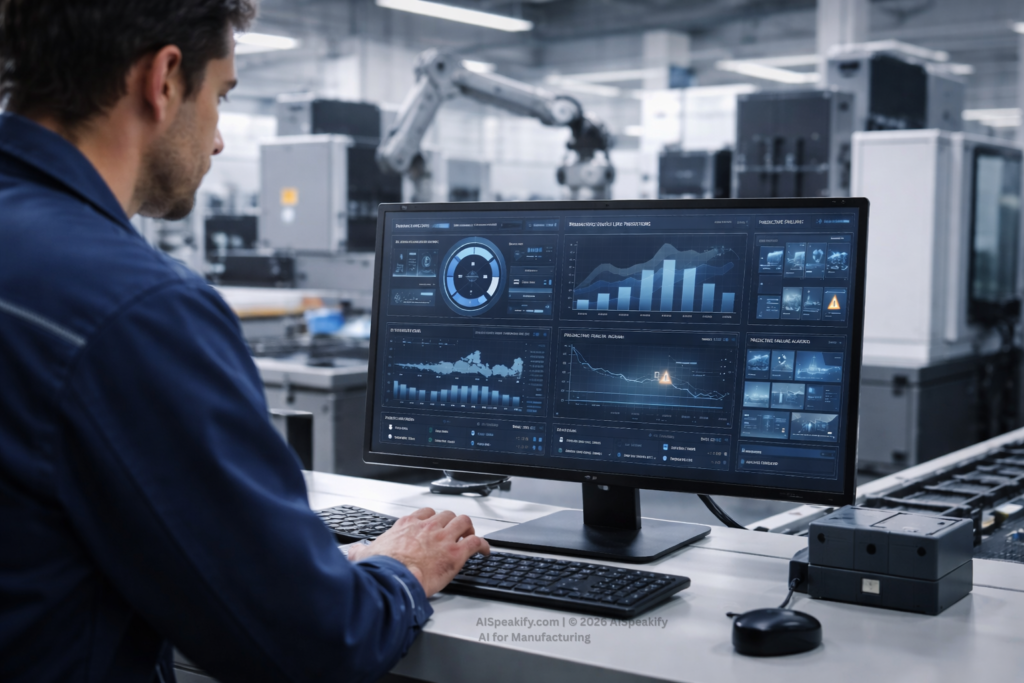
Siemens Senseye – Predictive Maintenance
Siemens Senseye is an industrial predictive maintenance platform designed to detect machine failures before breakdowns occur. The system analyzes sensor data from rotating equipment and industrial machinery to identify early indicators of mechanical degradation.
Key Capabilities:
- Machine failure prediction using AI models
- Remaining useful life (RUL) estimation
- Automated maintenance recommendations
- Integration with existing CMMS systems
Best for:
- Large manufacturing plants
- Predictive maintenance programs
- Asset reliability improvement
Deployment: Cloud-based
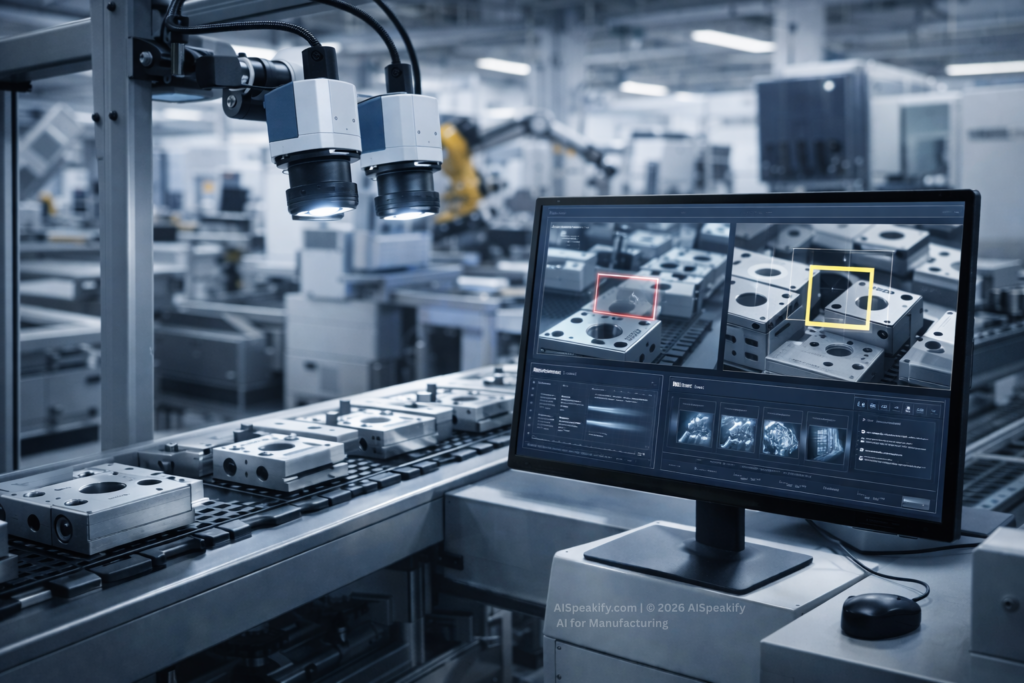
Landing AI (Vision Inspection)
Landing AI provides advanced computer vision tools for manufacturing quality inspection. The platform allows manufacturers to train defect detection models using small datasets, enabling automated visual inspection on production lines.
Key Capabilities:
- AI-powered defect detection
- Surface quality inspection
- Low-data model training
- Edge deployment for factory environments
Best for:
- Visual inspection and defect detection
- Electronics and semiconductor manufacturing
- Quality inspection automation using computer vision
Deployment: Edge AI + Cloud (hybrid)
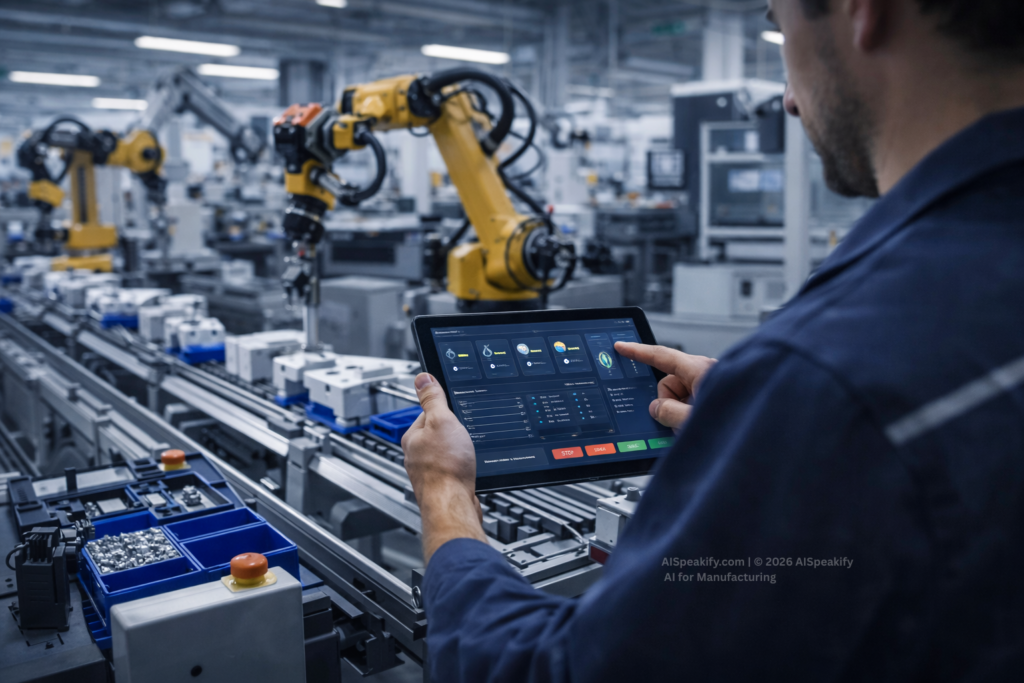
Tulip Interfaces
Tulip is a frontline operations platform that combines IoT connectivity with AI-powered analytics to improve manufacturing workflows, operator productivity, and real-time production visibility.
Key Capabilities:
- Real-time shop-floor data collection
- AI-driven production analytics
- No-code app building for manufacturing processes
- Integration with MES and ERP systems
Best for:
- Connected worker applications
- Shop-floor operations management
- Digital work instructions and production tracking
Deployment: Cloud-based with edge connectivity
Sight Machine
Sight Machine provides a manufacturing data platform that aggregates operational data across production systems to generate real-time performance insights and AI-driven optimization recommendations.
Key Capabilities:
- Manufacturing data unification
- OEE performance analytics
- Predictive process optimization
- Enterprise-scale analytics dashboards
Best for:
- Manufacturing analytics and data visibility
- OEE optimization and production performance monitoring
- Multi-plant industrial analytics
Deployment: Cloud-based analytics platform
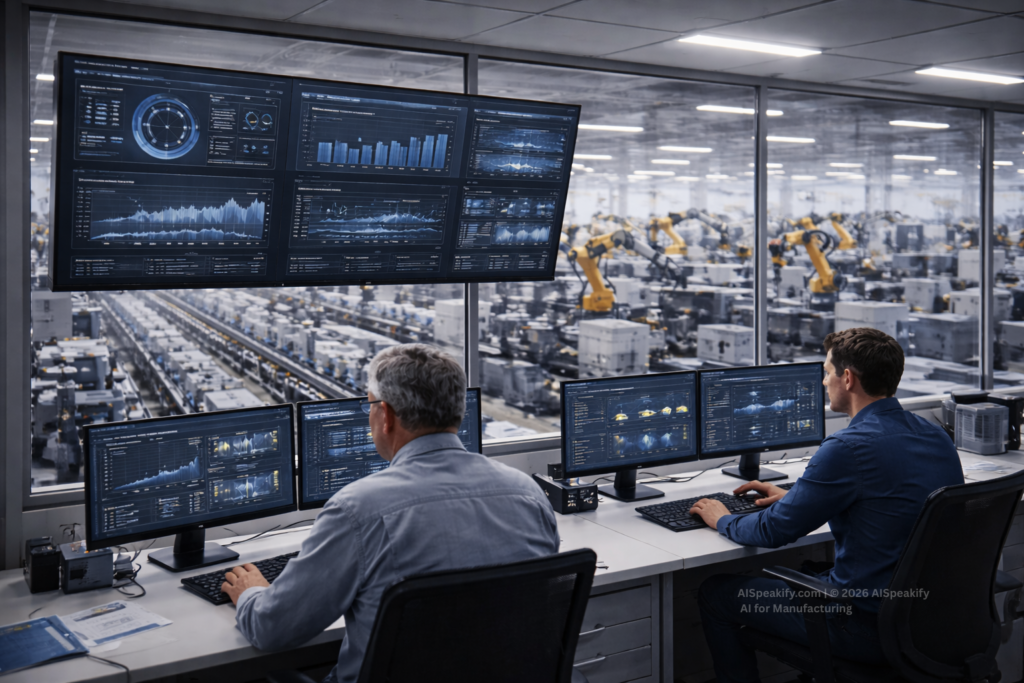
Falkonry
Falkonry is an industrial artificial intelligence platform designed to detect operational anomalies in manufacturing and industrial processes. The system uses machine learning models to analyze sensor data, identify abnormal patterns, and provide early warnings of equipment failures or process deviations.
Key Capabilities:
- Industrial anomaly detection
- Machine learning analysis of sensor data
- Early warning alerts for abnormal behavior
- Root cause analysis support
- Integration with industrial historians and IoT systems
Best for:
- Industrial anomaly detection
- Monitoring sensor-heavy manufacturing processes
- Predicting operational disruptions
Deployment: Edge + Cloud deployment
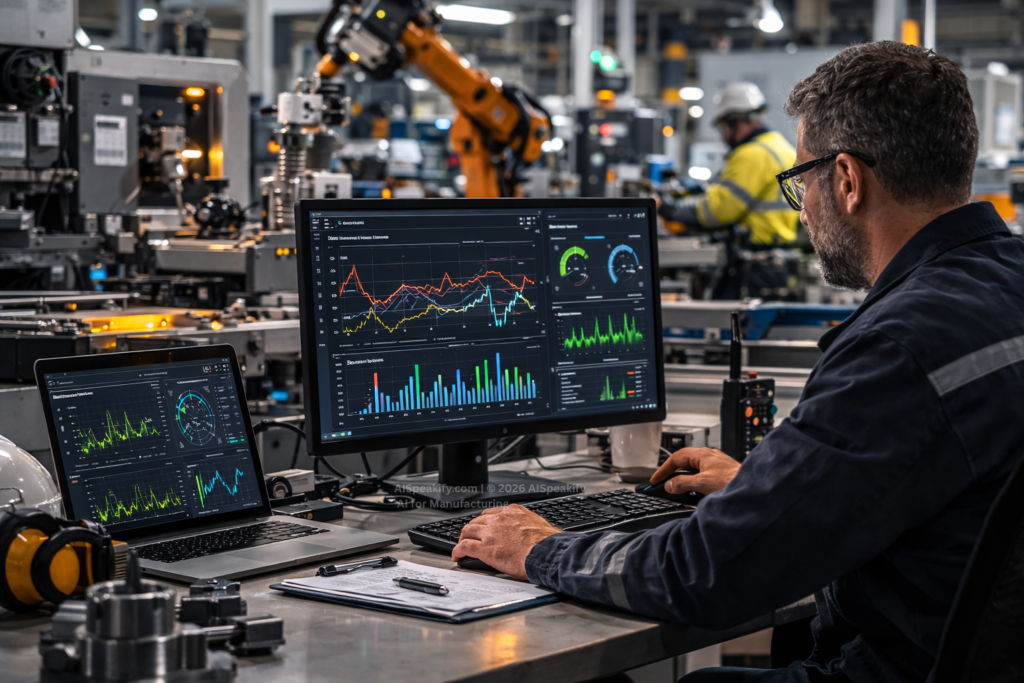
IBM Maximo (Maximo Predict)
IBM Maximo is a leading enterprise asset management platform that helps organizations manage the lifecycle of industrial assets such as machinery, equipment, and infrastructure. The platform combines asset management with artificial intelligence and predictive analytics to improve maintenance planning and equipment reliability.
Key Capabilities:
- Predictive maintenance analytics
- Enterprise asset lifecycle management
- Maintenance planning and scheduling
- IoT sensor data integration
- Asset performance monitoring
Best for:
- Enterprise asset management
- Predictive maintenance programs
- Managing large fleets of industrial equipment
Deployment: Cloud or On-Premise
Frequently Asked Questions
Manufacturers exploring artificial intelligence often have questions about how AI technologies work in industrial environments and what benefits they can deliver. The following frequently asked questions provide practical insights into how AI is transforming modern manufacturing operations.
What is AI used for in manufacturing?
Artificial intelligence is used in manufacturing to improve operational efficiency, reduce equipment downtime, and enhance product quality.
AI systems analyze machine data, production metrics, and sensor inputs to detect patterns that humans may not easily identify. These insights allow manufacturers to predict machine failures, automate quality inspection, optimize production schedules, and improve overall equipment effectiveness.
Common AI applications in manufacturing include predictive maintenance, computer vision inspection, production optimization, supply chain forecasting, and autonomous process control.
How does AI improve manufacturing efficiency?
Artificial intelligence improves manufacturing efficiency by analyzing large volumes of production data and identifying optimization opportunities across factory operations.
Machine learning algorithms can monitor equipment performance, detect anomalies, and recommend adjustments that reduce downtime and increase throughput. AI can also optimize production schedules, reduce bottlenecks, and improve resource utilization across the production line.
These capabilities allow manufacturers to increase productivity while maintaining high quality standards.
What are examples of AI tools used in manufacturing?
Several advanced AI platforms are widely used in manufacturing environments to support predictive maintenance, quality inspection, and operational analytics.
Examples of AI tools used in manufacturing include Siemens Senseye for predictive maintenance, Landing AI for computer vision inspection, Tulip for manufacturing operations applications, Sight Machine for industrial analytics, Falkonry for machine learning anomaly detection, and IBM Maximo for asset performance management.
These platforms help factories transform operational data into actionable insights that improve reliability and production performance.
What is predictive maintenance in manufacturing?
Predictive maintenance is a maintenance strategy that uses artificial intelligence and machine learning to predict when equipment failures are likely to occur.
Instead of relying on scheduled maintenance intervals, predictive maintenance systems analyze real-time sensor data such as vibration, temperature, pressure, and operational signals to detect early warning signs of machine degradation.
This approach allows manufacturers to perform maintenance only when needed, reducing unexpected equipment failures and minimizing production downtime.
How does computer vision work in manufacturing?
Computer vision systems use deep learning algorithms to analyze images captured by industrial cameras installed on production lines.
These systems automatically inspect manufactured parts and detect defects such as scratches, cracks, dimensional deviations, or assembly errors. Computer vision inspection systems can operate at high speed and high precision, making them ideal for automated quality control in modern factories.
By automating visual inspection tasks, manufacturers can reduce human error, improve product consistency, and increase inspection throughput.
Can AI integrate with existing manufacturing systems?
Yes. Artificial intelligence platforms are designed to integrate with existing manufacturing systems such as PLC controllers, SCADA systems, Manufacturing Execution Systems (MES), and Enterprise Resource Planning (ERP) platforms.
AI solutions typically connect to these systems through industrial data pipelines, IoT gateways, or API integrations. This allows manufacturers to leverage existing operational data while introducing advanced analytics and machine learning capabilities without replacing current infrastructure.
What are the benefits of AI in manufacturing?
Artificial intelligence provides several measurable benefits for manufacturing organizations by improving operational efficiency, reducing downtime, and enhancing product quality.
AI-powered systems can analyze large volumes of machine data to detect inefficiencies, predict equipment failures, and optimize production performance. This allows manufacturers to reduce unplanned downtime, improve production throughput, and maintain consistent product quality.
Key benefits of AI in manufacturing include increased equipment reliability, improved quality control, optimized production planning, reduced operational costs, and better decision-making through data-driven insights.
What industries use AI-driven manufacturing?
AI-driven manufacturing technologies are widely used across several industrial sectors that require high levels of precision, automation, and operational efficiency.
Industries such as automotive manufacturing, aerospace, electronics production, semiconductor fabrication, pharmaceutical manufacturing, and consumer goods production are actively adopting artificial intelligence technologies to improve production reliability and product quality.
These industries rely on AI systems for predictive maintenance, computer vision inspection, production optimization, and supply chain analytics.
Is AI replacing human workers in manufacturing?
Artificial intelligence is not replacing human workers in manufacturing but rather augmenting human capabilities and improving operational decision-making.
AI technologies automate repetitive and data-intensive tasks such as equipment monitoring, defect detection, and production analytics. This allows engineers, operators, and production managers to focus on higher-value activities such as process optimization, system supervision, and strategic decision-making.
Most modern smart factories use AI as a collaborative technology that enhances workforce productivity rather than replacing human expertise.